


“Reimagining Johannesburg: A New Dawn for Urban Governance”
At the very centre of Johannesburg, the city’s many contradictions are acutely visible where the energy and dynamism of vibrant street life stand in sharp contrast to the challenges posed by ageing and deteriorating infrastructure. This intersection is also marked by a powerful ambitious spirit that drives innovation and economic activity, even as longstanding institutional inertia threatens to slow progress. Against this backdrop, Johannesburg is entering a bold new phase, with stakeholders working collectively to redefine the urban experience and governance for a more inclusive and resilient future.
On 04 November 2025, the MAGALS Training Academy in Selby became the epicentre of a transformative dialogue. The Urban Management and Governance Workshop, convened under the Presidential Johannesburg Working Group (PJWG 8): Inner City and Townships, brought together a powerful coalition of changemakers, the City of Johannesburg, SALGA Gauteng, Gauteng COGTA, Jozi My Jozi (JMJ), the National School of Government (NSG), the Gauteng Precinct Management Association (GPMA) and a diverse array of stakeholders from civil society, academia, and the private sector.
This was not just another workshop. It was a catalytic moment, a convergence of minds, mandates, and movements united by a shared mission to reimagine Johannesburg as a World-Class African City that is inclusive, resilient, and governed with integrity.
The day unfolded with a sense of urgency and purpose. Keynote speaker Dr. Tanya Zack painted a vivid picture of Johannesburg’s inner city as a “mega retail port” pulsing with potential yet weighed down by systemic neglect. She challenged the room to see beyond decay and dysfunction to recognise the informal traders, taxi operators, and community champions who are already shaping the city’s future from the ground up.
International insights added a global lens to local challenges. Professor Xiaolin He of the Shanghai Administration Institute shared how China’s “digital twin” cities are using real-time data to manage risk and deliver services within a 15-minute radius and the model of integrated, citizen-centric governance offered a compelling blueprint for how Johannesburg might modernise its own systems.
But the most powerful voices came from the ground. Urban designers, community leaders, and city officials spoke candidly about the daily realities of managing a city in flux. They acknowledged the non-linear, negotiated nature of Johannesburg’s urban change where migration, informality, and local power dynamics often outpace formal planning. They called for a new kind of governance, i.e., adaptive, collaborative, and deeply rooted in the lived experiences of residents.
The workshop culminated in the adoption of a 10-point “Way Forward” framework, an ambitious yet grounded roadmap for action. From integrating the informal economy into formal value chains, to launching a real-time Urban Management Dashboard, to revitalising the CBD through the “My CBD, Our Pride” campaign, the plan is both visionary and implementable.
Among the standout commitments:
· The establishment of a Gauteng Cross-Border Economic Corridor Forum to align infrastructure and investment across municipalities.
· The institutionalisation of neighbourhood-level governance platforms to ensure communities are not just consulted but co-create solutions.
· A renewed focus on circular economy principles mainstreaming recycling, green entrepreneurship, and resource recovery into city projects.
· A commitment to international peer learning, with Shanghai and Singapore as anchor partners in Johannesburg’s modernisation journey.
Yet perhaps the most moving moment came during the “Personal Pledges” session. One by one, participants stood to declare their individual commitments ranging from mentoring new City Improvement Districts, launching community training programmes, increasing field visibility, and supporting the homeless. These were not abstract promises; they were declarations of intent, grounded in personal agency and professional responsibility.
As the workshop drew to a close, a resounding message emerged that the era of lengthy discussions and isolated planning is over. The future of Johannesburg hinges not on directives handed down from above or on the isolated efforts of individual departments. Instead, real progress will come from forging robust partnerships across sectors and communities. The city’s renewal will be fuelled by the strategic use of real-time data and analytics, enabling adaptive decision-making and responsive governance.
Ultimately, it will be the people of Johannesburg, those who live, work, and invest their energy in the city who drive and sustain meaningful transformation. Their collective action, commitment, and ingenuity will shape a city that is more inclusive, resilient, and vibrant for all.
The road ahead is long. But with a 24-month action plan in development, a Q1 2026 technical review on the horizon, and a policy brief will be sent to the Mayoral Committee, the wheels of change are already turning.
This is more than urban management. It is urban stewardship. It is about reclaiming the soul of Johannesburg, its streets, its spaces, its spirit and ensuring that every resident, from Hillbrow to Soweto, has a stake in the city’s rebirth.
The city is watching. The world is watching. And we are ready.
Prepared by: Gaethijwe Letlhaku
Senior Advisor – Economic Development
SALGA Gauteng
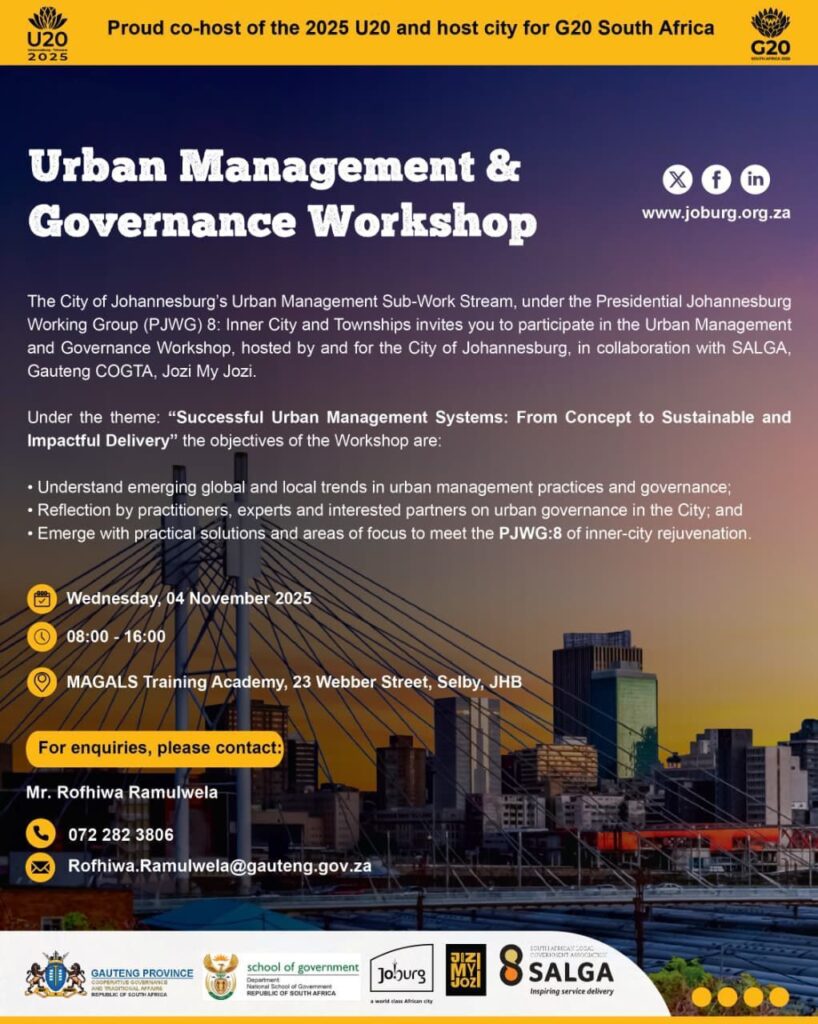
SALGA Workshop Tuesday 4 November


