


THE PROGRAMME MANAGEMENT OFFICE
A year of coordination, renewal, and city-shaping momentum
A methodology built for delivery
At the core of Jozi My Jozi’s success is a Programme Management Office (PMO) that follows a clear and disciplined methodology for taking projects from concept to execution. Every gateway begins with a thoughtfully crafted placemaking concept, developed with sponsors, designers, and City departments. The PMO refines these ideas into feasible proposals, aligns all stakeholders, and works with the city to incorporate essential infrastructure repairs, such as fixing pavements, restoring streetlights, and resolving service-delivery failures, into a single, consolidated project scope.
Once this unified scope is approved, the PMO coordinates the necessary permits and wayleaves, prepares a detailed implementation plan, and oversees delivery through structured progress meetings that keep every partner aligned. Throughout construction, the PMO troubleshoots challenges, resolves inter-departmental issues, and ensures that each element, from lighting to landscaping to public art, is executed to the highest standard.
Importantly, each project concludes with a sustainability plan. The PMO works with sponsors and City Improvement Districts to establish long-term maintenance and security models so that every gateway remains clean, safe, and cared for far beyond its installation. This structured, end-to-end approach ensures that every intervention is intentional, technically sound, and built to last.
Redefining the PMO for city-wide impact
This disciplined methodology anchored the PMO’s evolution in 2025, a year in which the office fundamentally strengthened its identity, systems, and delivery capacity. The PMO matured into the strategic engine of Johannesburg’s urban regeneration, bringing coherence to complex city-wide efforts and aligning government, business, and civil society behind a shared purpose. Through this transformation, the PMO became the force that turned intention into impact, demonstrating that urban renewal in Johannesburg is not only possible, but achievable at scale.
Flagship projects: The inner-city gateways
Transforming urban perception, one entry point at a time
Gateways are powerful storytellers. They are the places where people form an emotional impression of the city, where a single stretch of road or bridge communicates pride, identity, and possibility. When gateways are dark or neglected, they reinforce narratives of decay. When they are vibrant, clean, and intentional, they signal renewal.
In 2025, the PMO led the transformation of Johannesburg’s most visible and symbolic entry points. These interventions combined safety improvements, infrastructure repairs, public art, landscaping, and long-term stewardship, producing a new language of welcome across the city.
Nelson Mandela Bridge – A beacon of unity and renewal
The Nelson Mandela Bridge, a 284-metre structure spanning 42 railway lines, is one of Johannesburg’s most iconic landmarks. Opened by Nelson Mandela in 2003 as a symbol of unity between Braamfontein and Newtown, the bridge had deteriorated over time: broken glass panels, failing lights, graffiti, and unsafe walkways made it a hotspot for crime. Students and workers often crossed it in groups at night to protect themselves.
Recognising its symbolic importance, the PMO selected it as the first flagship gateway. ABSA sponsored a complete restoration, which the PMO coordinated from design to execution. Solar-powered LED lights, programmable and visible across the skyline, were installed. Glass panels were repaired, steel structures repainted, sidewalks resurfaced, and new crash barriers added. Mosaic benches
created by the Spaza Arts Trust were installed alongside powerful Constitution-themed murals by Dekor One.
When the lights came back on in June 2024, the city noticed. The bridge became a glowing declaration of possibility and proof that public-private collaboration could deliver tangible, high-quality impact. It set the tone for the broader gateway programme that followed.

Queen Elizabeth Bridge – A corridor brought back to life
Built in the 1950s, the Queen Elizabeth Bridge connects Braamfontein with the Newtown taxi rank. In 2025, the PMO led a complete revitalisation supported by FNB and the British High Commission. Landarch landscape architects spearheaded an intensive clean-up operation, removing years of grime, debris, and waste. Pavements were rebuilt with over 5,300 donated Corobrik bricks; trees were pruned; new flowerbeds were planted; and modern lighting was installed.
The Johannesburg Roads Agency repainted road markings and restored key infrastructure, while local artist Lazi Mathebula added expressive steel sculptures that celebrate Johannesburg’s everyday characters. This project brought new life to a vital commuter corridor and demonstrated the PMO’s ability to blend technical upgrades with creative placemaking.
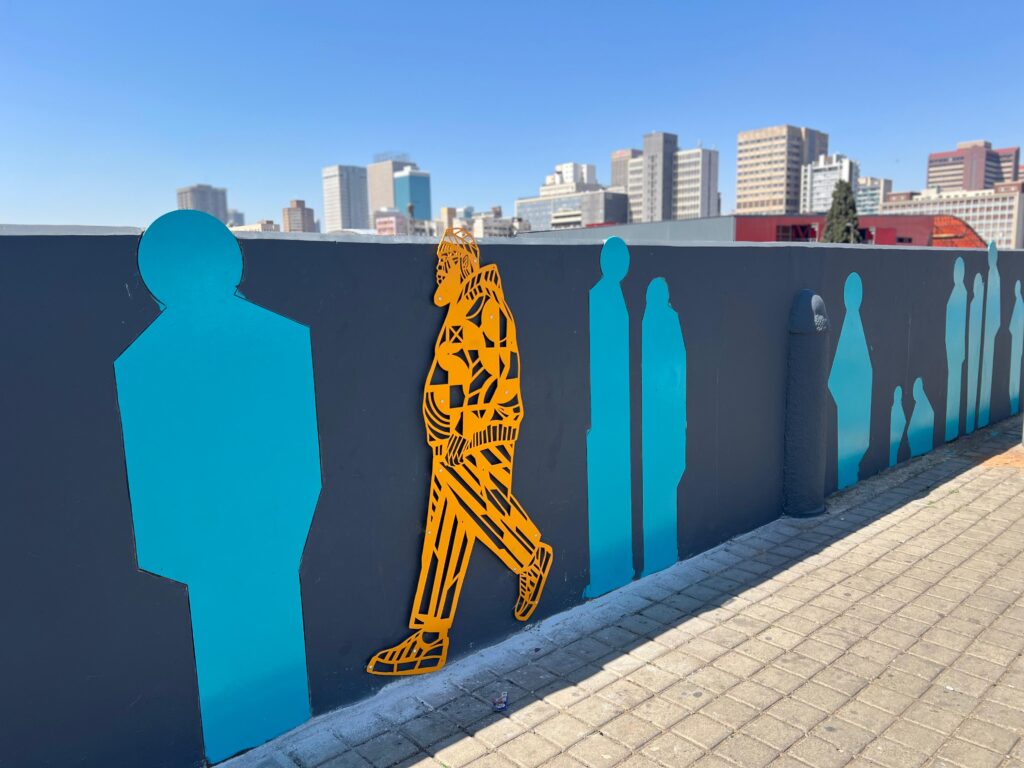
Jan Smuts Complex – Reimagining a critical urban node
The Jan Smuts Complex sits at the convergence of Empire Road, Ameshoff Street, and Bertha Street—one of the city’s busiest intersections. In 2025, the PMO advanced this ambitious project with KPMG, Old Mutual, Liberty, Wits University, and SALGA. Through design development, stakeholder alignment, and coordination with the Johannesburg Development Agency, the PMO prepared the site for construction, scheduled to begin in early 2026. This project represents an important collaboration between business, government, and academia.
Catalysing the M2 corridor
Mooi Street – Restoring a vital inner-city connector
Mooi Street is one of Johannesburg’s most important north–south corridors, serving thousands of commuters, residents, and small businesses each day. After years of deteriorating sidewalks, poor lighting, and unmanaged activity, the PMO advanced a full placemaking and infrastructure plan for its renewal in 2025.
Working with ABSA as the anchor sponsor, the PMO coordinated site assessments with the City of Johannesburg, the Johannesburg Roads Agency, and City Parks. Design work was completed, incorporating landscaping, solar lighting, pedestrian improvements, and safety enhancements. Technical scoping, costing, and wayleave approvals were finalised, preparing the project for implementation.
Mooi Street is now ready for activation in early 2026, where its transformation will strengthen pedestrian safety, uplift surrounding businesses, and re-establish the corridor as a clean, vibrant, and dignified gateway into the inner city.
Selby Street – Unlocking a challenging but high-potential underpass
Selby Street, located beneath the M2 motorway, has long been one of Johannesburg’s most complex gateway sites. The precinct faces deep structural challenges, limited lighting, and chronic under-maintenance, yet it remains a critical connector linking the inner city to surrounding mobility routes.
In 2025, the PMO made significant progress by completing engineering assessments to understand the structural work required beneath the M2. This groundwork ensures that placemaking can proceed safely and sustainably. In parallel, the PMO secured strong support from Standard Bank and the Maharishi Invincibility Institute, linking the Selby intervention to the vibrant Field of Dreams soccer precinct nearby.
A large mural adjacent to the Field of Dreams site is scheduled for completion in early 2026, creating a visual anchor that signals the area’s renewal. Further activation will follow in phases, coordinated with the structural timeline under the bridge.
Selby reflects the PMO’s ability to manage technically demanding spaces with patience, structure, and creativity, turning a long-neglected underpass into an emerging node of possibility.
The OR Tambo Gateway Corridor – Welcoming the World to Johannesburg
Gillooly’s Interchange & Albertina Sisulu
The OR Tambo Gateway Corridor forms one of Johannesburg’s most important arrival sequences, providing the first impression for millions of visitors travelling from OR Tambo International Airport into the city each year. As part of Johannesburg’s preparation for G20-related engagements, the PMO coordinated a series of interventions along this route to ensure that the city presents a dignified, intentional, and world-class welcome.
Gillooly’s Interchange, the busiest in the Southern Hemisphere, became the centrepiece of this effort. For decades, the large central meadow lacked identity, character, or visual focus. In 2025, the PMO worked with artist James Delaney, Investec, SANRAL, and Moja Nation Exchange to deliver a dramatic public-art installation featuring five life-sized steel zebras and around eighty soaring egrets. Positioned deliberately in a billboard-free zone, the sculptures transformed the interchange into a bold, unforgettable landmark that now signals creativity, confidence, and renewal to all arriving visitors. The intervention quickly became one of the city’s most photographed and celebrated public artworks, setting a new tone for Johannesburg’s eastern approach.

The PMO’s work along the OR Tambo Corridor extended beyond Gillooly’s. The Albertina Sisulu arterial, another critical route linking the airport to the inner city, underwent coordinated cleaning, vegetation clearing, debris removal, and early beautification efforts. These interventions were designed not only to improve the immediate environment, but also to lay the foundation for longer-term upgrades scheduled for the coming year. Together, they contributed to a more coherent and uplifting arrival experience, aligned with the city’s broader G20 readiness strategy.
Through these initiatives, the PMO ensured that Johannesburg’s gateway from OR Tambo reflects the pride, ambition, and creative energy of a city preparing to welcome the world.
Beyond gateways: A PMO driving citywide transformation
While the gateway programme has become one of the most visible expressions of JMJ, the PMO’s work extends far beyond the bridges, corridors, and entry points that define the city’s first impressions. In 2025, the PMO supported a broader portfolio of interventions aimed at strengthening Johannesburg’s safety, social infrastructure, and civic readiness. These initiatives reveal the depth and versatility of the PMO’s role, demonstrating that its impact reaches across neighbourhoods, communities, and strategic city assets.
Scaling safety through solar
Safety forms the foundational layer of all urban regeneration work. In 2025, the PMO coordinated the installation of five hundred solar-powered lights across the city’s key routes and precincts, significantly improving night-time visibility and contributing to safer pedestrian environments. The PMO also initiated planning for the next wave of solar installations, which will be rolled out in 2026 through strengthened partnerships with City departments and City Improvement Districts to ensure proper long-term maintenance.
Social infrastructure
The PMO’s contributions extended beyond physical infrastructure into the realm of social impact. In Soweto, ceiling repairs at Ezembemveni School were completed with the assistance of US aid workers, restoring safe learning conditions for students. Additional upgrades at Lufoni House–Gordon Terrace and Ekuthuleni shelters are now ready to proceed, forming part of a growing portfolio of social-development projects that complement the broader urban-renewal strategy.
G20 city readiness
As Johannesburg prepared for increased global visibility during G20-related engagements, the PMO focused on strengthening key civic precincts to ensure the city presented itself with confidence and care. At Constitution Hill, the PMO coordinated significant paving upgrades inside the precinct to improve access, movement, and overall visitor experience. This work was complemented by the paving of Kotze Street, enhancing the connection between Constitution Hill and Braamfontein’s urban fabric.
In parallel, the PMO advanced the revitalisation concept for Beyers Naudé Square at the request of the Presidency. Working closely with national partners, the PMO refined a vision that restores the square as a dignified, welcoming public space and prepared the project for activation in 2026.
Together, these interventions positioned Johannesburg’s civic heart as ready, intentional, and aligned with the city’s G20 ambitions.
The pipeline for 2026 and beyond
Scaling Johannesburg’s transformation
If 2025 was the year of demonstrating what coordinated delivery can achieve, then 2026 will be the year of scaling that achievement across the city.
The PMO now holds a robust and fully developed pipeline for the coming year. Major gateway projects, including Mooi Street, Selby, and the Jan Smuts Complex, are scheduled to enter implementation. These interventions will reshape mobility routes, strengthen pedestrian safety, and expand the network of high-quality public spaces across Johannesburg.
In addition, the PMO has advanced preparatory work on a series of gateways, including Smit Street, Carr Street, Pat Mbatha, Eloff Street, Charlton Terrace, Joe Slovo, and Enoch Sontonga, that are expected to enter final scoping, sponsorship engagement, and design phases during 2026. Once activated, these gateways will contribute to a continuous east-west and north-south network of clean, safe, and vibrant urban corridors.
The solar-lighting programme will expand significantly, supported by new maintenance partnerships and the integration of lighting with the city’s CCTV infrastructure. The PMO will also drive the next wave of social-infrastructure projects, including the next phase of work at Ezembemveni School. Civic initiatives such as the revitalisation of Beyers Naudé Square will move into detailed design and early construction.
A city rising through coordination
Through its work in 2025, the PMO demonstrated that Johannesburg’s renewal is possible when the city moves with coordination, commitment, and collective belief. Each gateway restored, each corridor lit, each school repaired, and each civic space re-imagined contributes to a larger story, a story of a city rising, not through isolated acts, but through disciplined partnership and shared purpose.
As the PMO steps into 2026, it does so with momentum, with clarity, and with a strengthened ecosystem of partners. The year ahead promises to be bolder and more ambitious. Johannesburg is not simply hoping for transformation; it is building it, and the PMO is at the centre of making that future real.


